

Das CHIME-Framework beschreibt fünf empirisch abgeleitete Recovery-Prozesse als Orientierungsrahmen für Unterstützung und Praxis. Es ist als Teil des übergeordneten Konzeptionelles Recovery Framework nach Leamy et al. 2011 zu verstehen.
Kernpunkte
- Connectedness: Beziehungen, soziale Unterstützung, Peer-Kontakte, Teilhabe
- Hope & optimism: Zuversicht, Motivation, Zukunftsorientierung, Ziele
- Identity: Selbstbild jenseits von Diagnose, Stigma-Umgang, multiple Identitäten
- Meaning in life: Werte, Rollen, Sinnquellen, Alltagsbedeutung
- Empowerment: Selbstbestimmung, Selbstwirksamkeit, Stärken- und Ressourcenfokus
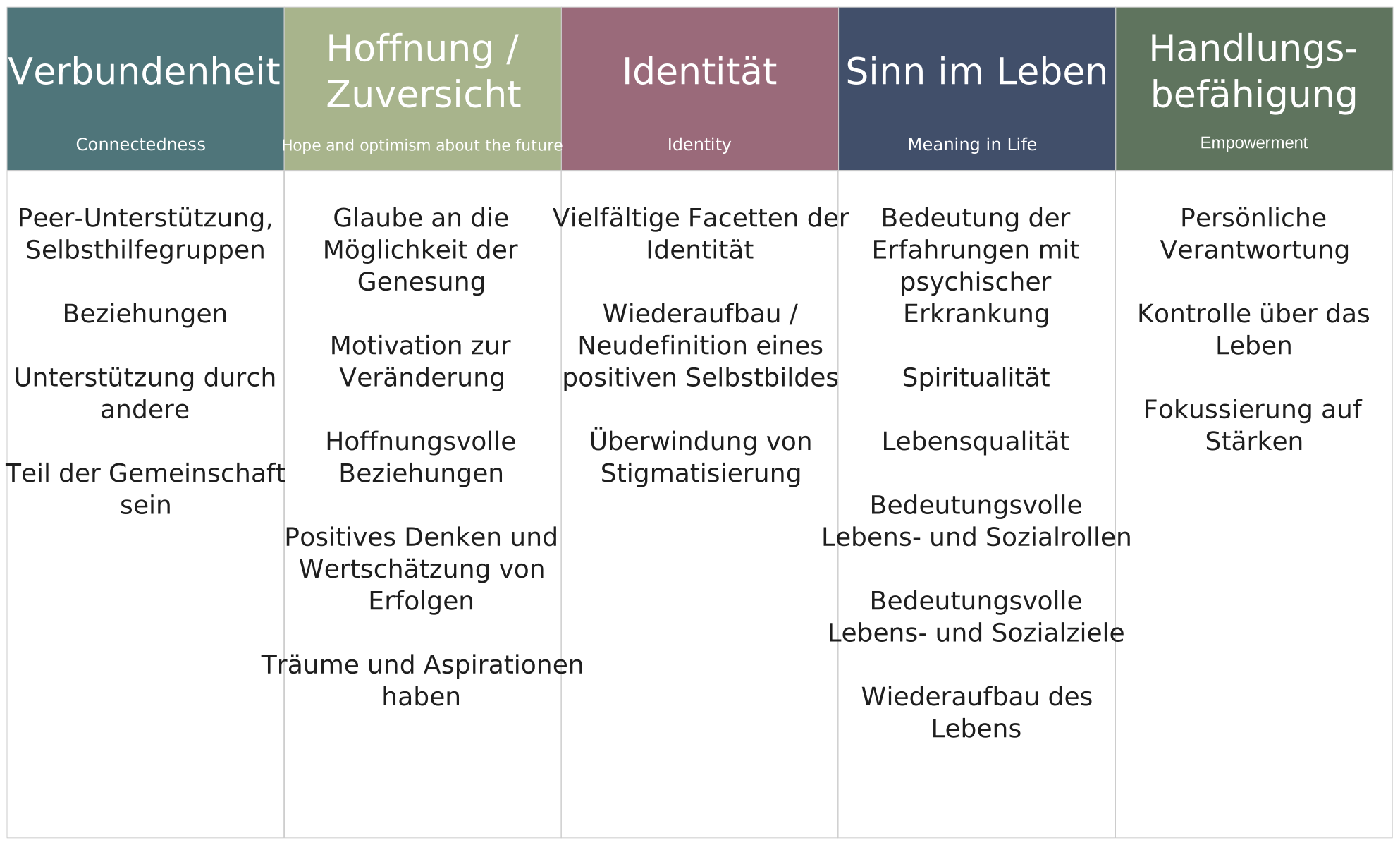
Links
- CHIME Themen
- Konzeptionelles Recovery Framework nach Leamy et al. 2011
- 360.Recovery CHIME Framework
Quellen
Anthony, W. A. (1993). Recovery from mental illness: The guiding vision of the mental health service system in the 1990s. Psychosocial Rehabilitation Journal, 16(4), 11–23. https://doi.org/10.1037/h0095655
Bird, V., Leamy, M., Tew, J., Le Boutillier, C., Williams, J., & Slade, M. (2014). Fit for purpose? Validation of a conceptual framework for personal recovery with current mental health consumers. Australian & New Zealand Journal of Psychiatry, 48(7), 644–653. https://doi.org/10.1177/0004867413520046
Deegan, P. E. (1988). Recovery: The lived experience of rehabilitation. Psychosocial Rehabilitation Journal, 11(4), 11–19. https://doi.org/10.1037/h0099565
Hare-Duke, L., Charles, A., Slade, M., Rennick-Egglestone, S., Dys, A., & Bijdevaate, D. (2023). Systematic review and citation content analysis of the CHIME framework for mental health recovery processes: Recommendations for developing influential conceptual frameworks. Journal of Recovery in Mental Health, 6(1), 38–44. https://doi.org/10.33137/jrmh.v6i1.38556
Idris, A., Md Akhir, N., Mohamad, M. S., & Sarnon, N. (2023). Exploring the Lived Experience on Recovery from Major Depressive Disorder (MDD) among Women Survivors and Five CHIME Concepts: A Qualitative Study. Behavioral Sciences, 13(2), 151. https://doi.org/10.3390/bs13020151
Knuf, A. (2020). Recovery und Empowerment (Neuausgabe). Psychiatrie Verlag.
Lases, M. N., Bruins, J., Scheepers, F. E., Van Sambeek, N., Ng, F., Rennick-Egglestone, S., Slade, M., Van Balkom, I. D. C., & Castelein, S. (2024). Is personal recovery a transdiagnostic concept? Testing the fit of the CHIME framework using narrative experiences. Journal of Mental Health, 1–9. https://doi.org/10.1080/09638237.2024.2361225
Leamy, M., Bird, V., Boutillier, C. L., Williams, J., & Slade, M. (2011). Conceptual framework for personal recovery in mental health: Systematic review and narrative synthesis. British Journal of Psychiatry, 199(6), 445–452. https://doi.org/10.1192/bjp.bp.110.083733
Liberman, R. P., & Kopelowicz, A. (2002). Recovery from schizophrenia. A challenge for the 21st century. International Review of Psychiatry, 14(4), 245–255. https://doi.org/10.1080/0954026021000016897
Onken, S. J., Craig, C. M., Ridgway, P., Ralph, R. O., & Cook, J. A. (2007). An analysis of the definitions and elements of recovery: A review of the literature. Psychiatric Rehabilitation Journal, 31(1), 9–22. https://doi.org/10.2975/31.1.2007.9.22
Piat, M., Seida, K., & Sabetti, J. (2017). Understanding everyday life and mental health recovery through CHIME. Mental Health and Social Inclusion, 21(5), 271–279. https://doi.org/10.1108/MHSI-08-2017-0034
Senneseth, M., Pollak, C., Urheim, R., Logan, C., & Palmstierna, T. (2022). Personal recovery and its challenges in forensic mental health: Systematic review and thematic synthesis of the qualitative literature. BJPsych Open, 8(1), e17. https://doi.org/10.1192/bjo.2021.1068
Slade, M., Leamy, M., Bacon, F., Janosik, M., Le Boutillier, C., Williams, J., & Bird, V. (2012). International differences in understanding recovery: Systematic review. Epidemiology and Psychiatric Sciences, 21(4), 353–364. https://doi.org/10.1017/S2045796012000133
Slade, M., & Wallace, G. (2017). Recovery and Mental Health. In M. Slade, L. Oades, & A. Jarden (Hrsg.), Wellbeing, Recovery and Mental Health (S. 24–34). Cambridge University Press.
Stuart, S. R., Tansey, L., & Quayle, E. (2017). What we talk about when we talk about recovery: A systematic review and best-fit framework synthesis of qualitative literature. Journal of Mental Health, 26(3), 291–304. https://doi.org/10.1080/09638237.2016.1222056
Williams, L., Armitage, C., Richardson, A., Davies, F., Smith, A., & Adnath, J. (2023). Service user experiences of participating in a Recovery and Collaborative Care Planning Café framed with CHIME: ‘A co-produced narrative paper’. Journal of Recovery in Mental Health, 6(2), 90–96.