

Leamy et al. (2011) bündeln Recovery-Literatur zu einem konzeptionellen Rahmen aus drei komplementären Komponenten: Merkmale, Stufenmodell und Prozesse (CHIME). Das Framework beschreibt personal Recovery als aktiv, individuell, nicht-linear und multidimensional.
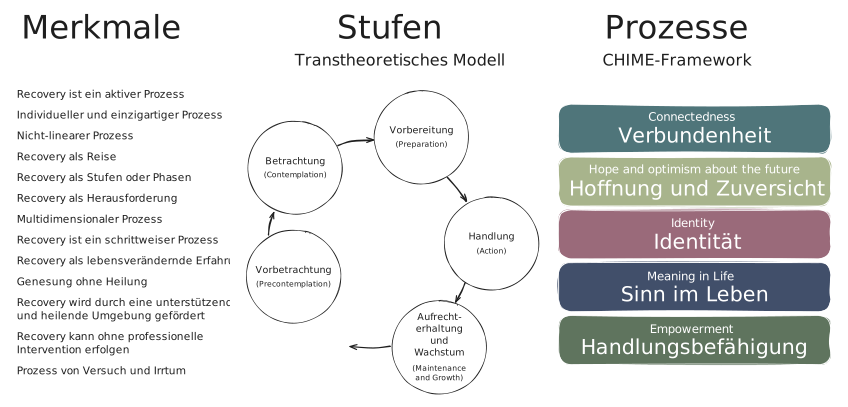
Kernpunkte
1) Merkmale von Recovery (Charakteristika)
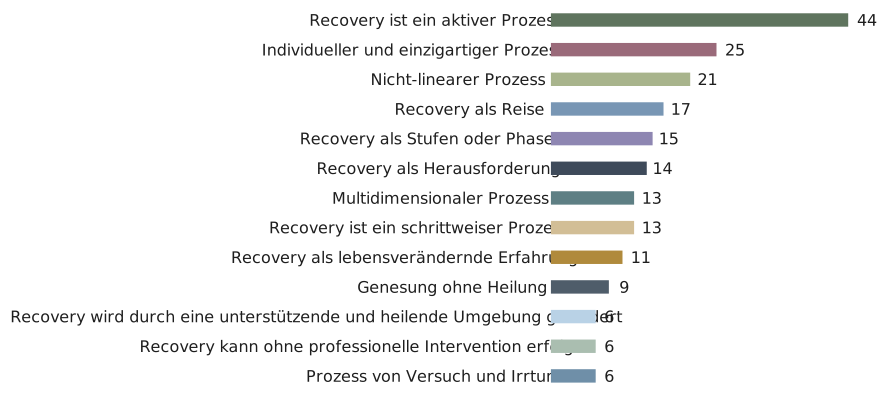
Abbildung 2. Merkmale von Recovery Die Abbildung zeigt Charakteristika von Recovery, basierend auf einer Metaanalyse von 97 Studien (Leamy et al., 2011). Die Daten sind nach Häufigkeit der Nennung der Merkmale sortiert. Basierend auf Leamy et al. (2011, S. 448, Tabelle 1). Darstellung und Übersetzung: Joel Roerick.
2) Stufenmodell (Transtheoretisches Modell in Leamy-Begriffen)
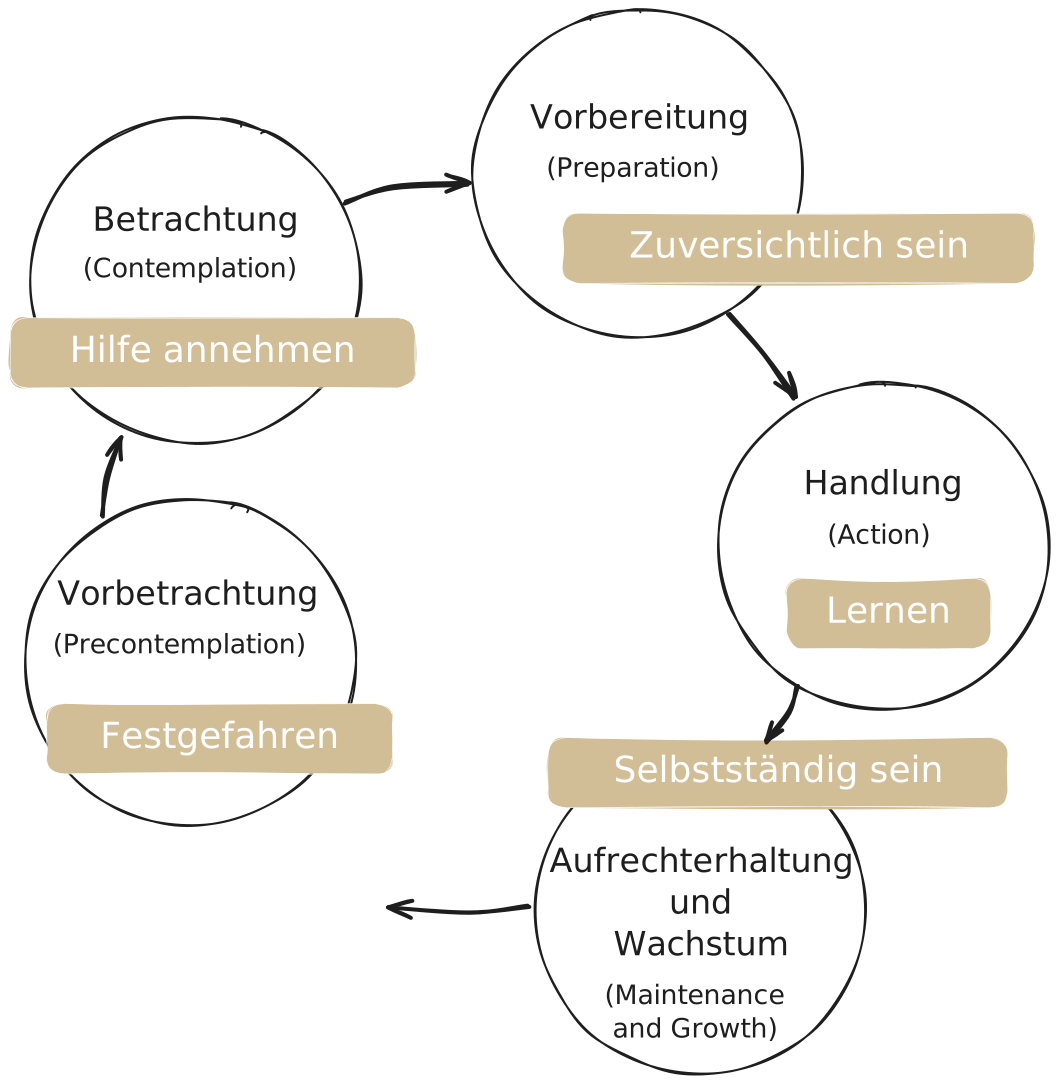
Abbildung 3. Transtheoretisches Modell Darstellung des Transtheoretischen Modells in den von Leamy et al. (2011) verwendeten Stufen, ergänzt durch alternative Begrifflichkeiten aus einer von Leamy et al. wiedergegebenen, anonymisierten Studie. Basierend auf Leamy et al. (2011, S. 449, Tabelle 3). Darstellung und Übersetzung: Joel Roerick.
3) Prozesse (CHIME-Framework)
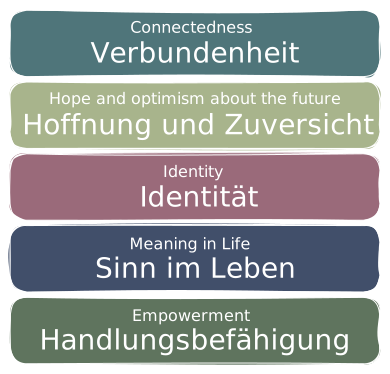
Abbildung 4: CHIME-Prozesse Die Abbildung stellt die fünf Prozesse des CHIME-Frameworks vor. Basierend auf Leamy et al. (2011, S. 448, Tabelle 2). Darstellung und Übersetzung: Joel Roerick.
Links
Quellen
Anthony, W. A. (1993). Recovery from mental illness: The guiding vision of the mental health service system in the 1990s. Psychosocial Rehabilitation Journal, 16(4), 11–23. https://doi.org/10.1037/h0095655
Bird, V., Leamy, M., Tew, J., Le Boutillier, C., Williams, J., & Slade, M. (2014). Fit for purpose? Validation of a conceptual framework for personal recovery with current mental health consumers. Australian & New Zealand Journal of Psychiatry, 48(7), 644–653. https://doi.org/10.1177/0004867413520046
Deegan, P. E. (1988). Recovery: The lived experience of rehabilitation. Psychosocial Rehabilitation Journal, 11(4), 11–19. https://doi.org/10.1037/h0099565
Hare-Duke, L., Charles, A., Slade, M., Rennick-Egglestone, S., Dys, A., & Bijdevaate, D. (2023). Systematic review and citation content analysis of the CHIME framework for mental health recovery processes: Recommendations for developing influential conceptual frameworks. Journal of Recovery in Mental Health, 6(1), 38–44. https://doi.org/10.33137/jrmh.v6i1.38556
Idris, A., Md Akhir, N., Mohamad, M. S., & Sarnon, N. (2023). Exploring the Lived Experience on Recovery from Major Depressive Disorder (MDD) among Women Survivors and Five CHIME Concepts: A Qualitative Study. Behavioral Sciences, 13(2), 151. https://doi.org/10.3390/bs13020151
Knuf, A. (2020). Recovery und Empowerment (Neuausgabe). Psychiatrie Verlag.
Lases, M. N., Bruins, J., Scheepers, F. E., Van Sambeek, N., Ng, F., Rennick-Egglestone, S., Slade, M., Van Balkom, I. D. C., & Castelein, S. (2024). Is personal recovery a transdiagnostic concept? Testing the fit of the CHIME framework using narrative experiences. Journal of Mental Health, 1–9. https://doi.org/10.1080/09638237.2024.2361225
Leamy, M., Bird, V., Boutillier, C. L., Williams, J., & Slade, M. (2011). Conceptual framework for personal recovery in mental health: Systematic review and narrative synthesis. British Journal of Psychiatry, 199(6), 445–452. https://doi.org/10.1192/bjp.bp.110.083733
Liberman, R. P., & Kopelowicz, A. (2002). Recovery from schizophrenia. A challenge for the 21st century. International Review of Psychiatry, 14(4), 245–255. https://doi.org/10.1080/0954026021000016897
Onken, S. J., Craig, C. M., Ridgway, P., Ralph, R. O., & Cook, J. A. (2007). An analysis of the definitions and elements of recovery: A review of the literature. Psychiatric Rehabilitation Journal, 31(1), 9–22. https://doi.org/10.2975/31.1.2007.9.22
Piat, M., Seida, K., & Sabetti, J. (2017). Understanding everyday life and mental health recovery through CHIME. Mental Health and Social Inclusion, 21(5), 271–279. https://doi.org/10.1108/MHSI-08-2017-0034
Senneseth, M., Pollak, C., Urheim, R., Logan, C., & Palmstierna, T. (2022). Personal recovery and its challenges in forensic mental health: Systematic review and thematic synthesis of the qualitative literature. BJPsych Open, 8(1), e17. https://doi.org/10.1192/bjo.2021.1068
Slade, M., Leamy, M., Bacon, F., Janosik, M., Le Boutillier, C., Williams, J., & Bird, V. (2012). International differences in understanding recovery: Systematic review. Epidemiology and Psychiatric Sciences, 21(4), 353–364. https://doi.org/10.1017/S2045796012000133
Slade, M., & Wallace, G. (2017). Recovery and Mental Health. In M. Slade, L. Oades, & A. Jarden (Hrsg.), Wellbeing, Recovery and Mental Health (S. 24–34). Cambridge University Press.
Stuart, S. R., Tansey, L., & Quayle, E. (2017). What we talk about when we talk about recovery: A systematic review and best-fit framework synthesis of qualitative literature. Journal of Mental Health, 26(3), 291–304. https://doi.org/10.1080/09638237.2016.1222056
Williams, L., Armitage, C., Richardson, A., Davies, F., Smith, A., & Adnath, J. (2023). Service user experiences of participating in a Recovery and Collaborative Care Planning Café framed with CHIME: ‘A co-produced narrative paper’. Journal of Recovery in Mental Health, 6(2), 90–96.