

Bei Bedarf seitlich scrollen.
| CHIME-Thema | Zugeordnete Schutzfaktoren |
|---|---|
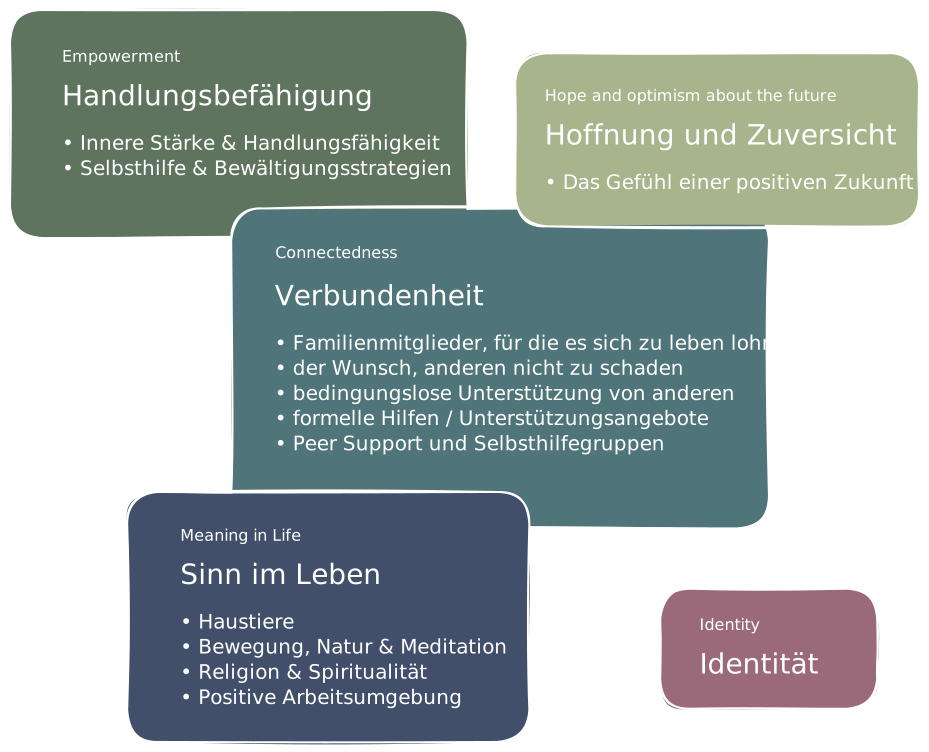
| C – Connectedness | Soziale Unterstützung |
| H – Hope (Hope & Optimism) | Hoffnung; Optimismus; Positive Emotionen |
| I – Identity | Selbstwertgefühl; Kohärenzgefühl |
| M – Meaning | Religiosität und Spiritualität |
| E – Empowerment | Selbstwirksamkeitserwartung; Kontrollüberzeugungen; Coping; Hardiness |
Vollständigkeit
Alle im Werk von Bengel & Lyssenko (2012) dargestellten psychologischen Schutzfaktoren sind in dieser Zuordnung enthalten. Die Zuordnung folgt einer konzeptionellen Logik innerhalb des CHIME-Frameworks und vermeidet Mehrfachnennungen, außer dort, wo sie fachlich notwendig wären.
Literatur
Bengel, J. & Lyssenko, L. (2012). Resilienz und psychologische Schutzfaktoren im Erwachsenenalter: Stand der Forschung zu psychologischen Schutzfaktoren von Gesundheit im Erwachsenenalter. BZgA.
Boydell, K. M., Nicolopoulos, A., Macdonald, D., Habak, S. & Christensen, H. (2023). Understanding protective factors for men at risk of suicide using the CHIME framework: The primacy of relational connectedness. International Journal of Environmental Research and Public Health, 20(3), 2259. https://doi.org/10.3390/ijerph20032259
Fredrickson, B. L. (2001). The role of positive emotions in positive psychology: The broaden-and-build theory of positive emotions. American Psychologist, 56(3), 218-226. https://doi.org/10.1037/0003-066X.56.3.218
Leamy, M., Bird, V., Le Boutillier, C., Williams, J. & Slade, M. (2011). Conceptual framework for personal recovery in mental health: Systematic review and narrative synthesis. British Journal of Psychiatry, 199(6), 445-452. https://doi.org/10.1192/bjp.bp.110.083733
Rutter, M. (1987). Psychosocial resilience and protective mechanisms. American Journal of Orthopsychiatry, 57(3), 316-331. https://doi.org/10.1111/j.1939-0025.1987.tb03541.x