

Perspectives · Mindfulness · Dialogue
Social work.
Nothing about us without us.
konsent.one connects practical methods, texts, learning offers and projects for social work. The work follows three themes: perspectives, mindfulness and dialogue.
Consent-based decision-making is one part of this work. Proposals are developed together, reasoned objections are taken seriously and agreements are shaped for everyday practice.

What konsent.one works on
Three themes
 01
01Perspectives
Recovery and orientation in everyday life, change, tension and crisis.
 02
02Mindfulness
Body-based, everyday and accessible ways to notice, regulate and act.
 03
03Dialogue
Participation, facilitation and shared decisions on equal footing.
A shared decision-making practice
What is Konsent?
At konsent.one, Konsent means consent-based decision-making. Consent is not consensus: the difference sounds small, but it changes the logic of a decision.
Consensus asks: Is everyone in favour?
Consent asks: Is there a reasoned, serious objection?
People do not have to be enthusiastic about a proposal. They need to be able to work with it. Objections are treated as information: they can reveal blind spots, protect people from being overruled and help improve a proposal.
Dialogical decision-making (DDM) adapts this practice for social work, counselling, teams and facilitation. Tension, proposal, objection and agreement belong together, and agreements must be concrete enough to hold in everyday life.
Consent-based decision-making in social work · doi.org/10.5281/zenodo.20417970
Methods and practice frameworks
Tools for practice
Four approaches turn the three themes into practical orientation, conversations and shared action.

Compass for Personal Recovery
A practice framework for recovery in everyday life, crisis and tension.
konsent.one/recovery-kompass (German)
Mindfulness-based recovery practice
A mindfulness-based approach to recovery and CHIME.
konsent.one/achtsame-recovery (German)
Dialogical decision-making
Proposals, objections and workable agreements.
konsent.one/dialogisch-entscheiden (German)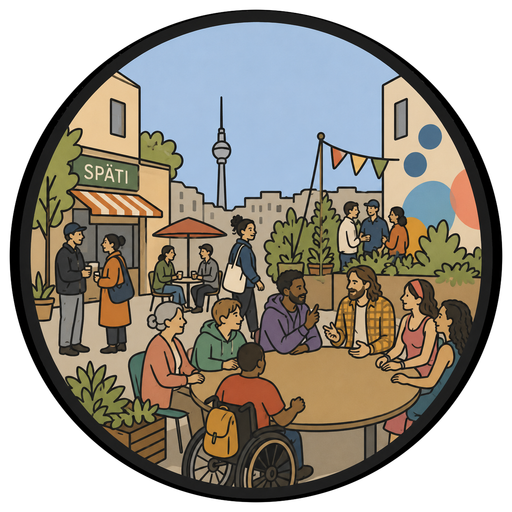
Kiezmachen (quartermaking)
Recovery-oriented neighbourhood facilitation: strengthening relationships and making participation possible.
konsent.one/kiezmachen (German)From the workshop
Texts
Working papers, essays and concept papers are collected here. Published texts use persistent DOI links; drafts are marked until their DOI versions are released.
4 September 2026
Living a Good Life — Despite Everything
CHIMEplus connects the five CHIME processes with PERMA, resilience promotion, person-centred future planning and mindfulness: an orientation framework for crisis work and recovery in community mental health that keeps self-determination, relationships and social conditions in view.
German full textdoi.org/10.6084/m9.figshare.33369028
24 August 2026
Mindfulness-Based Recovery (AbR)
A position paper connecting mindfulness, recovery, resource-oriented practice and CHIME: mindful activities as low-threshold practice for community mental health, self-determination and a good life despite everything.
German full textdoi.org/10.6084/m9.figshare.33296007
23 August 2026
Mettā — a building block of Mindfulness-Based Recovery (AbR)
A short German-language loving-kindness practice with professional context: friendly wishes as a mindful activity for self-compassion, self-care and compassionate agency in community mental health.
German full textdoi.org/10.6084/m9.figshare.33324972
20 August 2026
Mindful gardening with psychiatric diagnoses
A method outline for mindful gardening with people who need support: gardening as informal mindfulness practice, connected with CHIME, recovery and a dialogically safe group frame.
German full textdoi.org/10.6084/m9.figshare.33295824
16 August 2026
Dialogue as a Practice of Shared Understanding
This theory paper frames dialogue as a shared practice of understanding: before a workable decision, experiences, perspectives, concepts, reasons and objections must form a sufficiently shared frame of reference. It reads proposal, objections and agreement as movements of shared understanding - without requiring unanimity and with clear limits: dialogue does not remove power, and shared understanding can be collectively wrong.
German full textdoi.org/10.6084/m9.figshare.33265125
16 August 2026
Acting consistently without punishing
The dialogical sequence of consequences is a jointly pre-agreed, graduated series of clarification steps - from stage 0, strengthening positive interaction, through feedback and conversations in growing circles to a formal consequence. Version 2 can begin with tensions even before a workable agreement exists; consequences in the narrower sense only begin where a clear, jointly agreed and checkable agreement repeatedly fails to hold.
German full textdoi.org/10.6084/m9.figshare.32969582
14 August 2026
Pause, notice, arrive: a German-language adaptation of the STOP exercise as a brief mindfulness practice for everyday life and social work.
German full textdoi.org/10.6084/m9.figshare.33253572
13 August 2026
A low-threshold health-promotion method for social work: psychoeducational, behaviour-preventive and practical for individual and group work.
German full textdoi.org/10.6084/m9.figshare.33245754
3 August 2026
Dialogical decision-making (dEf): theoretical foundations of an evidence-informed method
A theoretical and evidence-informed grounding of dialogical decision-making for shared decisions under structural power asymmetry — combining consent, resistance polling and a dialogical sequence of consequences.
German full textdoi.org/10.6084/m9.figshare.33126938
12 July 2026
Kiezmachen — relationships, not addresses
Recovery-oriented neighbourhood facilitation for the inclusion of people with mental illness: Who expects a person? Who stays approachable?
German full textdoi.org/10.6084/m9.figshare.32969420
23 June 2026
Methodological foundations of the Compass for Personal Recovery
Origins and scientific grounding of the three pillars crisis, resilience and recovery — the reference base for further development.
German full textdoi.org/10.6084/m9.figshare.32969498
21 June 2026
Dialogical decision-making as a stance
DDM not as a formal procedure but as an everyday stance: phrase everything as a proposal, listen for tensions, actively invite objections.
German full textdoi.org/10.6084/m9.figshare.32969567
12 June 2026
Sociocracy, consent and dialogical decision-making
Historical and conceptual positioning: from the Boekes via Endenburg to Sociocracy 3.0 — and why this leads to the working term DDM for social work.
German full textdoi.org/10.6084/m9.figshare.32969576
12 June 2026
Dialogical decision-making — a personal introduction
Three decades of experience in non-hierarchical groups, combined with a professional framing of DDM as method and stance.
German full textdoi.org/10.6084/m9.figshare.32969573
12 June 2026
"Isn’t this all far too complicated?"
Why dialogical decision-making is not a methods problem but a culture change: from duel to dialogue, from person to issue.
German full textdoi.org/10.6084/m9.figshare.32969579
June 2026
The DDM process for workable agreements in social work: proposal, objections, agreement — not "Is everyone in favour?" but "Does anyone have a paramount objection?".
German full textdoi.org/10.6084/m9.figshare.32969561
June 2026
Leading with dialogical decision-making: strong leadership that fully submits to jointly agreed rules.
German full textdoi.org/10.6084/m9.figshare.32969585
13 July 2026
The Compass for Personal Recovery — a method outline
Toolbox and crisis recovery coaching along everyday life, tension and crisis — following the principle "everyday life first".
German full textdoi.org/10.6084/m9.figshare.32969489
2026
A curriculum of blank pages — a course concept built around the "Next Level Gardener" approach, a gardening metaphor for personal development.
German full textdoi.org/10.6084/m9.figshare.32969543
16 July 2025
Conceptual considerations on recovery in disability support; a central reference text for the Compass for Personal Recovery and work with crisis, everyday life and future.
German full textdoi.org/10.5281/zenodo.22172042
14 July 2024
Facilitation of community in neighbourhood contexts: social space understood not as a list of services, but as a network of viable relationships.
German full textdoi.org/10.5281/zenodo.20390741
2024
Zukunftsladen — "I plan my participation myself"
Concept for a place where people plan their own participation — with recovery at the centre, around a round table.
German full textdoi.org/10.6084/m9.figshare.32969414
22 July 2022
Consent-based decision-making in social work
English-language version of the early working paper on consent-based decision-making in person-centred, non-directive social work.
English full textdoi.org/10.5281/zenodo.20417970
22 July 2022
Konsent-Entscheidungsfindung in der Sozialen Arbeit
Early German-language working paper on the use of consent-based decision-making in person-centred, non-directive social work.
German full textdoi.org/10.5281/zenodo.20405958
About konsent.one
A professional workspace for social work
konsent.one brings together clear knowledge, practical methods, shared learning and projects. The content is meant to be understandable and professionally precise at the same time.
Different ways in
A practitioner may need a short explanation for a team conversation. Someone else may be looking for a worksheet. A student may need research and sources. All can begin with the same topic and decide how far they want to go.
How the areas connect
Themes provide orientation. Methods turn ideas into practice. Materials support concrete work. Projects test ideas in wider settings. Courses and professional training are offered on konsent.training.
What informs the work
PERMA from positive psychology (Seligman, 2011), the relentlessly positive RAID approach (Davies, 2000) and Carl Rogers' person-centred approach inform how wellbeing, empathy, unconditional positive regard and authenticity are understood here.
CHIME (Leamy et al., 2011), the UN Convention on the Rights of Persons with Disabilities (United Nations, 2006) and questions of social justice keep relationships, participation and fair conditions in view. These perspectives are connected without being merged into one theory.
Jewish social ethics and traditions of learning and justice shape the ethos of the work without forming a separate subject area on konsent.one or konsent.training. The speech Remembrance, not Innovation traces these roots in social work (Roerick, 2025). Havruta points to learning together, Machloket to reasoned disagreement and Tzedakah to action that protects dignity and rights.
References
- Davies, W. (2000). The RAID manual. APT Press.
- Leamy, M. et al. (2011). Conceptual framework for personal recovery in mental health. doi.org/10.1192/bjp.bp.110.083733
- Roerick, J. (2025). Remembrance, not Innovation.
- Rogers, C. (2017). Der neue Mensch (11th ed.). Klett-Cotta.
- Seligman, M. E. P. (2011). Flourish. Free Press.
- United Nations. (2006). Convention on the Rights of Persons with Disabilities.