

Das CHIME-Framework beschreibt fünf empirisch abgeleitete Prozesse persönlicher Recovery. Es dient als Orientierungsrahmen für Unterstützung, Praxis und Forschung. Es ist Teil des übergeordneten Konzeptionellen Recovery Frameworks nach Leamy et al. 2011.
CHIME erweitert den Blick über Symptomfreiheit hinaus. Die fünf Bereiche werden nicht für jeden Menschen gleich und nicht in einer festen Reihenfolge bearbeitet.
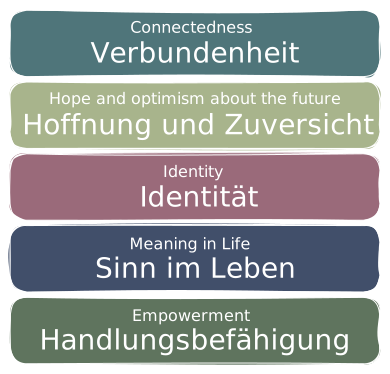
Die fünf Bereiche
- Connectedness: Beziehungen, soziale Unterstützung, Peer-Kontakte, Teilhabe
- Hope & optimism: Zuversicht, Motivation, Zukunftsorientierung, Ziele
- Identity: Selbstbild jenseits von Diagnose, Stigma-Umgang, multiple Identitäten
- Meaning in life: Werte, Rollen, Sinnquellen, Alltagsbedeutung
- Empowerment: Selbstbestimmung, Selbstwirksamkeit, Stärken- und Ressourcenfokus
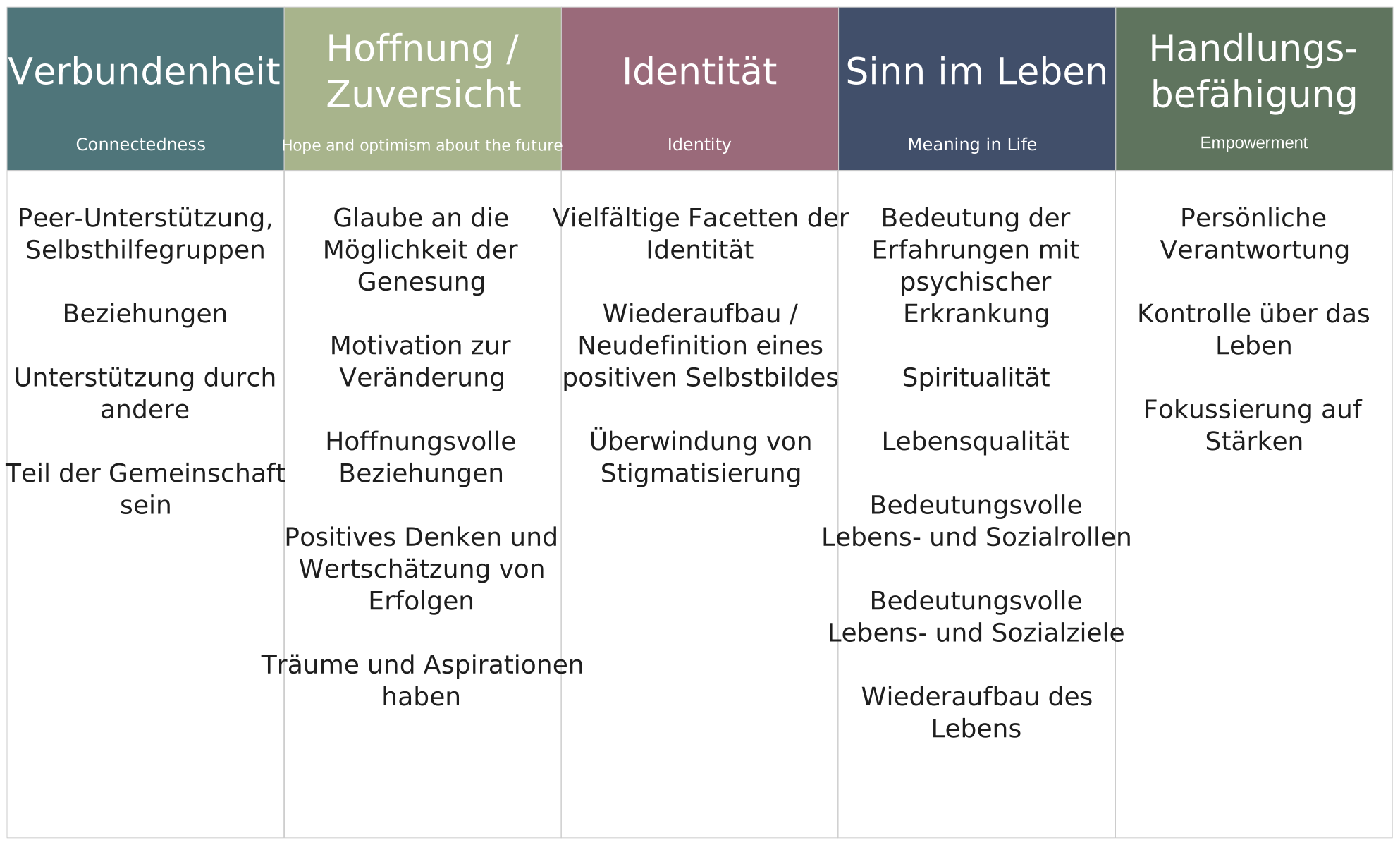
Zusammenklang als Bild
„Chime“ bedeutet im Englischen Glockenklang, Zusammenklang oder Klingen. Als Bild für Recovery macht das Wort deutlich: Die fünf Bereiche sind unterscheidbar, wirken aber zusammen.
- Recovery entsteht nicht durch das Abarbeiten einer Checkliste. Mehrere Bereiche können gleichzeitig „mitklingen“ und das Leben stimmiger machen.
- Ein Bereich kann zeitweise leiser werden, ohne dass alles scheitert.
- Kleine Schritte, zum Beispiel ein Kontakt, ein sinnstiftender Moment oder ein Gefühl von Selbstwirksamkeit, können das Ganze wieder in Bewegung bringen.
Praxisnutzen
Im Gespräch hilft das Bild des Zusammenklangs, Stärken, Bedürfnisse und nächste Schritte zu erkunden, ohne Recovery auf eine Norm oder feste Reihenfolge zu reduzieren.
Verwandte Zettel
Literatur
Anthony, W. A. (1993). Recovery from mental illness: The guiding vision of the mental health service system in the 1990s. Psychosocial Rehabilitation Journal, 16(4), 11–23. https://doi.org/10.1037/h0095655
Bird, V., Leamy, M., Tew, J., Le Boutillier, C., Williams, J., & Slade, M. (2014). Fit for purpose? Validation of a conceptual framework for personal recovery with current mental health consumers. Australian & New Zealand Journal of Psychiatry, 48(7), 644–653. https://doi.org/10.1177/0004867413520046
Deegan, P. E. (1988). Recovery: The lived experience of rehabilitation. Psychosocial Rehabilitation Journal, 11(4), 11–19. https://doi.org/10.1037/h0099565
Hare-Duke, L., Charles, A., Slade, M., Rennick-Egglestone, S., Dys, A., & Bijdevaate, D. (2023). Systematic review and citation content analysis of the CHIME framework for mental health recovery processes: Recommendations for developing influential conceptual frameworks. Journal of Recovery in Mental Health, 6(1), 38–44. https://doi.org/10.33137/jrmh.v6i1.38556
Idris, A., Md Akhir, N., Mohamad, M. S., & Sarnon, N. (2023). Exploring the Lived Experience on Recovery from Major Depressive Disorder (MDD) among Women Survivors and Five CHIME Concepts: A Qualitative Study. Behavioral Sciences, 13(2), 151. https://doi.org/10.3390/bs13020151
Knuf, A. (2020). Recovery und Empowerment (Neuausgabe). Psychiatrie Verlag.
Lases, M. N., Bruins, J., Scheepers, F. E., Van Sambeek, N., Ng, F., Rennick-Egglestone, S., Slade, M., Van Balkom, I. D. C., & Castelein, S. (2024). Is personal recovery a transdiagnostic concept? Testing the fit of the CHIME framework using narrative experiences. Journal of Mental Health, 1–9. https://doi.org/10.1080/09638237.2024.2361225
Leamy, M., Bird, V., Le Boutillier, C., Williams, J., & Slade, M. (2011). Conceptual framework for personal recovery in mental health: Systematic review and narrative synthesis. British Journal of Psychiatry, 199(6), 445–452. https://doi.org/10.1192/bjp.bp.110.083733
Liberman, R. P., & Kopelowicz, A. (2002). Recovery from schizophrenia. A challenge for the 21st century. International Review of Psychiatry, 14(4), 245–255. https://doi.org/10.1080/0954026021000016897
Onken, S. J., Craig, C. M., Ridgway, P., Ralph, R. O., & Cook, J. A. (2007). An analysis of the definitions and elements of recovery: A review of the literature. Psychiatric Rehabilitation Journal, 31(1), 9–22. https://doi.org/10.2975/31.1.2007.9.22
Piat, M., Seida, K., & Sabetti, J. (2017). Understanding everyday life and mental health recovery through CHIME. Mental Health and Social Inclusion, 21(5), 271–279. https://doi.org/10.1108/MHSI-08-2017-0034
Senneseth, M., Pollak, C., Urheim, R., Logan, C., & Palmstierna, T. (2022). Personal recovery and its challenges in forensic mental health: Systematic review and thematic synthesis of the qualitative literature. BJPsych Open, 8(1), e17. https://doi.org/10.1192/bjo.2021.1068
Slade, M., & Wallace, G. (2017). Recovery and Mental Health. In M. Slade, L. Oades, & A. Jarden (Hrsg.), Wellbeing, Recovery and Mental Health (S. 24–34). Cambridge University Press.
Slade, M., Leamy, M., Bacon, F., Janosik, M., Le Boutillier, C., Williams, J., & Bird, V. (2012). International differences in understanding recovery: Systematic review. Epidemiology and Psychiatric Sciences, 21(4), 353–364. https://doi.org/10.1017/S2045796012000133
Stuart, S. R., Tansey, L., & Quayle, E. (2017). What we talk about when we talk about recovery: A systematic review and best-fit framework synthesis of qualitative literature. Journal of Mental Health, 26(3), 291–304. https://doi.org/10.1080/09638237.2016.1222056
Williams, L., Armitage, C., Richardson, A., Davies, F., Smith, A., & Adnath, J. (2023). Service user experiences of participating in a Recovery and Collaborative Care Planning Café framed with CHIME: ‘A co-produced narrative paper’. Journal of Recovery in Mental Health, 6(2), 90–96.